How a set works (2-player rules)
- 7 cards per hand , the rest in the center (stack). A second pile called stash , at first empty.
- You select the ball's weight (1, 2, 3, 5, 8): this is the minimum force of a shot (recommended: 2).
First exchange
The first player serves: he lays 1 to 7 of his cards on the table to form a valid word
or beginning of a word (a sequel) with a value at least equal to the weight.
Then he draws the same amount of cards that he played (ALWAYS 7 in hand).
- The player can use as many jokers as he wishes.
- Don't reveal the word you have in mind unless someone challenges you !
🎾 Fair play : If the player serves below the weight (NET), the played cards are dumped in the stash and the
player is entitled to a second serve. If he makes NET again, the same applies but he loses his serve.
The stash remains untouched until someone wins a game. The next player serves.
The next player can:
- pass : if he cannot/does not want to play, he passes his turn.
- challenge the last sequel formed: “What are you thinking of ?” Either nothing (bluff),
or a word that needs checking in the dictionary of your choice. The player found to be in the wrong will be penalized*.
- "return": he tops up the sequel with 1 to 7 of his cards that he can put anywhere. He can also:
🎾 remove cards (which join the stash)
🎾 reorder any card
Then he draws as many cards as he has played.
🎾🎾🎾 The sequel must remain valid and be worth at least
its initial value plus the weight. 🎾🎾🎾
right handside insert
FOREHAND
left handside insert
REVERSE
Rearrangement
LIFTED REVERSE
Scattered inserts
LIFTED FOREHAND
Joker replaces letter
DROP SHOT
E joins the stash
Entire replacement
LOB
T, E, N join the stash
Any shot below the weight is called NET.
It has the same result as passing but allows you to discard weak/unwanted cards.
Any shot of 13 points or more is considered on the BASELINE .
🎾 CHAIR UMPIRE rule 🎾
Any shot NET or BASELINE may be reviewed upon anyone's request, without any risk to the requester. (cf Penalties )
Then it's the next player's turn and so on until someone passes or is being challenged.
GAME ! exchange is over.
The last player who hasn't passed wins the exchange (GAME). He takes all cards from the table
and the stash, and adds them to his pile of tricks (face down).
ACE !
If you score directly on your service you earn X additional Bonus cards
(X being the highest value on the table)
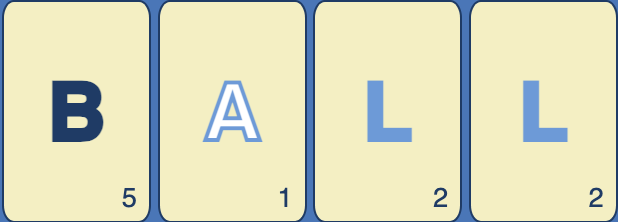 B = 5 points
=> 5 cards
🎾 This rule remains valid as long as all players have 7 cards in hand.
🎾 If the stack is insufficient for the bonus, the server wins ALL remaining cards in the game (opponents' hands) and the
set ends immediately!
PENALTY !
following a dispute, the player who is in the right is rewarded exactly as if he had scored an ace (table + stash +
bonus)
New game ! the loser serves a new exchange.
If he has lost following a penalty, the winner serves.
🎾 🎾 🎾 and so on until the end of the stack 🎾 🎾 🎾
Once the stack empty, the following rules apply:
🎾 There's no ace nor second service any more.
A player who nets won't be able to serve anymore.
🎾 Any shot can be challenged without risk (CHAIR UMPIRE).
Set Point
The set ends when :
🎾 a player wins a game with no card left in his hand : he wins all the potential remaining hands.
🎾 no one left is able to serve (systematic NET): all remaining hands are simply discarded and no one wins them.
🎾 a penalty applies: all remaining cards (table, stash, hands) go to the "right" player, and the "wrong" is
inflicted a 13 points malus to be substracted from his final score.
After the set the players count their tricks which determine the final score.
GAME, SET… and MATCH !
Who has the highest score wins the set, and therefore scores 1 point in the overall match score.
Then a new set begins, and so on.
If several players are tied, they play a tie-break: all the cards are gathered into a new pile and shuffled, and seven cards
are dealt to each player. The player following the last player to have played serves, and the first to win two games in a row
(regardless of the number of points) wins the set.
🎾🎾🎾🎾 The first player to win two sets wins the match! 🎾🎾🎾🎾
🎾🎾🎾🎾🎾🎾🎾🎾🎾🎾🎾🎾
Three-player match
🎾🎾🎾🎾🎾🎾🎾🎾🎾🎾🎾🎾
The rules are identical, expect these two following:
Pass : the first player to pass during a game can no longer play (lay cards or challenge) for the remainder of this game.
Penalties: In the event of a dispute, the player who is proved "right" collects the table and the stash, but the malus cards
are given to the third player.
Penalties: the bonus cards will go to the third player if this one hasn't passed yet (otherwise to the player in the "right").
🎾🎾🎾🎾🎾🎾🎾🎾🎾🎾🎾🎾
Double match (2 against 2)
🎾🎾🎾🎾🎾🎾🎾🎾🎾🎾🎾🎾
Two teams of two face off: each consists of one "baseline" player (who also serves) and one "volley" player.
Players keep their positions till the end of the set then swap.
(Baseline-Volley-NET-Volley-Baseline).
Naturally, the baseline players need to hit harder: we will say that baseline must hit "heavy" weight and volley "light" weight.
Therefore before starting the players must define a pair of weights among 1-2, 2-3, 3-5 and 5-8.
Subsequently, the harder you hit the ball, the further it will go; so that you can "aim" your opponent: hard shots will touch
baseline, soft shots will touch volley.
If the receiver can't play (MISS), his partner can rush in to the rescue and "SMASH", provided an extra effort equal to his partner's
weight.
🎾🎾🎾🎾🎾🎾🎾🎾🎾🎾🎾🎾
Example with a 3-5 weight pair (Blue VS Red)
Blue baseline serves. If his sequel is worth :
a/ less than 5 pts, he NETs. 2d Service, etc.
b/ between 5 and 8 (8=5+3, or heavy weight + light weight), the ball lands on Red Volley, who must add min 3 points (L.W.) to the
sequel.
c/ above 8, the ball lands on Red Baseline, who must add min 5 points (H.W.).
b/ If Red Volley misses the ball, Red Baseline can "SMASH", but needs to add the light weight to his shot, so 5+3=8 pts minimum.
Reversely if Red Baseline passes, Red Volley can SMASH, and needs to add the heavy weight to his shot, so 3+5=8 pts as well.
Any red player can spontaneously decide to smash before his partner plays.
After smashing, the ball lands on volley if you added less than 11pts (8+3), on baseline beyond.
If you missed but your partner smashed, you're still in the game (missing is not passing).
A game is won when no member of a team can play.
 1 pt x8
 2 pt x5
 3 pt x3
 5 pt x2
 8 pt x1
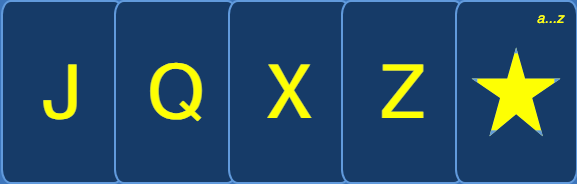
 any letter
 consonant
 vowel